
Farm Business & Operations
Croptraker Customer Spotlight: Heritage Grown

Located near Tillsonburg, Ontario, Heritage Grown embodies a deep-rooted farming legacy. Officially incorporated in 2019, the family business stems from generations of agricultural experience. Farmers John and Tina Dyck joined forces with their sons, Ivan and Jonathan, merging three family farms into a thriving enterprise. This collaboration fosters growth for the entire family and extends to other regional farms who lease land to Heritage Grown.
Data security check-up: password management

This article is the first part of our ongoing security series.
It’s not a new piece of advice: where there’s a login, there’s risk of security breach – following best password practices will provide protection and reassurance. The threat of having data compromised is widely understood, but research suggests that commitment to digital security remains lax for most individuals from its American sample. So maybe... the Dos and Don’ts are a little foggy.
Data security check-up: SaaS permissions

This article is the second installment of our ongoing security series.
Having all your important tasks and stats held in a service provider’s cloud storage is now normal. As we covered in our first data security post, this means good data security hygiene is a collective effort, led by managers that organize team members’ tool access mindfully. Software as a Service, or SaaS, has reframed software as a licensed subscription that is accessible online rather than relying on local storage of the tools and user data. Organized by user permissions, access to information and its controls can be precisely managed.
Digging into Soil Heath: Remediation and Regeneration with Croptracker

Healthy soil is not merely dirt; it is the living foundation upon which all productive and sustainable agriculture is built. Without vibrant, well-managed soil, crop yields suffer, and environmental challenges mount, impacting the very viability of farming operations. Soil degradation manifests in critical issues such as acidification, nutrient imbalances, heightened soil compaction, and salinization – diminishing nutrient levels and compromising long-term soil productivity and sustainability.
Drone Technology In Agriculture

The use of drones in almost every sector of the economy is growing fast, but drone usage in the agricultural industry is booming. According to some reports, the agricultural drone market is expected to grow from a $1.2 billion(USD) industry in 2019 to $4.8 billion in 2024. From scouting to security, drone use will become more ubiquitous on large and small scale farms in a few short years. The information gathered by drones on farms is often used to better inform agronomic decisions and is part of a system generally referred to as ‘precision agriculture’.
Emerging Ag-Tech: Solar Panels and Vehicles in Agriculture

This article is an update on our Emerging Ag-Tech series focused on solar energy technology. We include an agrovoltaic overview and new agrovoltaic installations and technology examples. We have also included a spotlight on new solar-powered farm vehicles.
Empowering Female Growers

Research shows that female growers are on the rise. The share of U.S. farms operated by women nearly tripled over the past three decades, according to a study by the USDA’s Economic Research Service, which analyzed gender roles in the Census of Agriculture from 1978 to 2007.
Exciting Implications of Century-Long Soil Study

World Soil Day falls on December 7th and it has the importance of soil as a lifeblood of horticulture and the planet on our minds. In this week's blog post we look at a monumental 100 year-long study into soil health, and the promising findings it's made regarding how growers can improve their soil health and yields, and how organic growers in particular can match conventional yields. We'll also look at how the study has highlighted the need to bridge the gap between scientific studies and practical application. Finally, we'll discuss how Croptracker helps growers conduct their own longitudinal studies, helping them get the most out of experimental trials and make more informed decisions for their operations.
Expanding to meet industry needs: Croptracker enters South American market with Spanish translations, new Director of Sales

The Organization for Economic Cooperation and Development (OECD) and Food and Agriculture Organization of the United Nations (FAO) reported in its 2019-2028 Agricultural Outlook that strong growth opportunities are anticipated in high value fruit and vegetable crops throughout Latin America and the Caribbean within the decade. As demand for fresh produce from these regions increases, so does the need for refined data insight tools for growers and distributors alike. The Croptracker team is excited to facilitate enhanced efficiency and regulatory compliance to the South American fruit and vegetable market – particularly through our Harvest Quality Vision system that produces pre-sorting harvest insights without the huge, costly packline.
Farm Record Keeping Software: What It Does and How to Choose
Harvest is wrapped. The bins are counted, the last spray record is (hopefully) written down somewhere, and audit season is open. Between now and the end of the year, GAP auditors, buyers, and your accountant will all ask the same question: can you show me the records?
If the answer means digging through notebooks, whiteboard photos, and a spreadsheet someone's nephew built in 2019, you're not alone — but you're also paying for it in audit prep hours, wage-law exposure, and traceability risk. This article covers what farm record keeping software actually does, which records a specialty crop operation needs to keep, and how to choose a system that fits the way you farm.
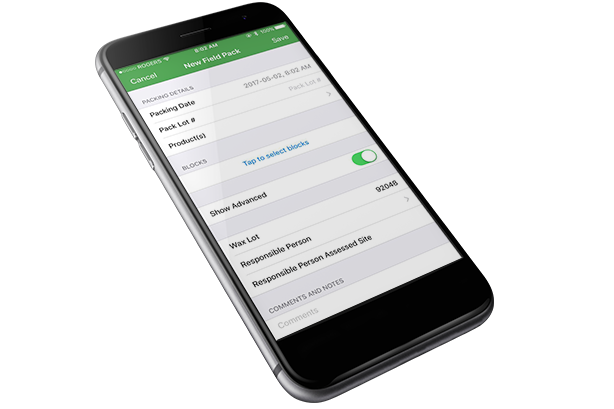
Feature Spotlight: Croptracker for Contact Tracing

As the covid-19 crisis continues, we have seen packing and agricultural workers testing positive across North America. Experts agree that contact tracing will be needed going forward to avoid bursts of new Coronavirus infections, which could lead to complete shut downs of many essential operations.
Feature Use Case: NPK Fertilizer Active Ingredient Tracking
In today's highly regulated agricultural landscape, tracking fertilizer applications by the brand name and application rate alone is no longer sufficient for comprehensive nutrient analysis or environmental impact reporting. With combination fertilizers, juggling multiple active ingredients can feel like guesswork. Fortunately, Croptracker's Spray module and Active Ingredient tracking features are built to eliminate that uncertainty.
Feeding Tomorrow: Consumer Trends Set to Shape the Horticulture Industry

With spring on the horizon, we've been inspired to look ahead to the future. In today's blog post, we take a look at four consumer food trends that will undoubtedly have a big impact on the horticulture industry, and discuss how Croptracker can help growers make the most of them.
Five Reasons Users Love The Total Work Cost Report

Managing costs is always at the forefront of any operation, and at Croptracker we believe that you can’t manage what you can’t measure.
Foodtech Spotlight: AI that can taste

As AI becomes increasingly ubiquitous - it’s in your phone, it’s tagging your photos, it’s selling you t-shirts on Instagram and it’s even delivering your food - questions about the role artificial intelligence should play in our daily lives, and what it is that really sets us apart as humans have been coming up more and more.
From Agtech to Foodtech

Autonomous tractors, robot weeding, even smart sorting machines and pack lines are all examples of advanced agtech innovations that have been widely accepted in the industry. But when it comes to transforming produce into the actual food we eat, there has been a hesitancy to adopt the same autonomous technologies.
Fruit & Vegetable Farm Size Steadily Growing

The size of fruit and vegetable growing operations in the U.S. is steadily increasing, according to a new report by the U.S. Department of Agriculture’s Economic Research Service. The midpoint acreage (half of farms are below the midpoint acreage and half the farms are above it) for fruit, nut and berry operations increased in 19 of 20 crops between 1987 and 20 12. During the 25-year period, all fruit operations barring lemon farms (which declined by 16%) grew in size.
Fruit or Vegetable: Fresh Food Facts

Commonly used terminology for the categories of fresh food we enjoy – fruits and vegetables – are often misnomers. From a culinary terminology standpoint, fruits are sweet and vegetables are not. Though it may vary depending on one’s background and region, generally the highlight of the public’s classification knowledge regarding what is a fruit and what is a vegetable is the fun fact of “Did you know that tomatoes are actually a fruit?!”
Getting Ready To Pack With Croptracker
We hope the 2018 growing season has been a successful one for you! In today's blog post, we're going to go over some tune-up procedures you should execute prior to starting packing with Croptracker.
Growing After the Storm: US Growers Face Hurricane Aftermath

Agricultural damage from this month's Hurricane Michael is predicted to top $1.3 billion, with Florida and Georgia bearing the brunt of the losses. Just a month ago, Hurricane Florence caused an estimated $1.1 billion in damage in North Carolina and an estimated $125 million in South Carolina.
While the dollar figures alone are tragic, there is also the unquantifiable human impact. 2017's Hurricane Irma - which caused $2.5 billion in damage to Florida's agriculture industry - caused several citrus and tomato growers to shut down operations. Among them was one of the state's oldest tomato-growing families, Big Red Tomato. Naturally, as this year's vicious Atlantic Hurricane Season continues to rage, there are concerns that 2018's growing season may be the last for more growers.
Request your free private demo now!
Let our expert staff walk you through the Croptracker system, and answer any questions you have.
We are here to help.