
The FSMA 204 Food Traceability Final Rule is FDA's recordkeeping rule for foods on its Food Traceability List — including most fresh-cut produce, melons, leafy greens, tomatoes, cucumbers, sprouts, and fresh herbs. It requires covered companies to capture records at specific supply-chain events, assign traceability lot codes, and produce complete traceability data to FDA within 24 hours of a request.
If you grow, pack, ship, or receive any of those commodities, the rule applies to your operation. And even though the enforcement date moved to 2028, the clock on your preparation window is already running.
Here's where things stand as of October 2026, what the rule actually requires at each stage of your workflow, and how to close the gap before it matters — because your retail buyers aren't waiting for FDA to ask.
What FSMA 204 Requires, in Grower Terms
FSMA 204 is one sentence long if you strip the legalese: for every food on the Food Traceability List, you must know where each lot came from and where it went, and prove it on demand.
In practice, that breaks down into five requirements:
- A written traceability plan that describes your procedures, the records you keep, and who is responsible (21 CFR 1.1315).
- Traceability lot codes (TLCs) assigned at defined points in your supply chain, so every lot has a unique, permanent identifier.
- Records at each critical tracking event (CTE) capturing the key data elements (KDEs) FDA specifies for that event.
- Two years of record retention (21 CFR 1.1455(d)).
- Everything available to FDA within 24 hours of an official request — plus an electronic sortable spreadsheet within 24 hours when FDA needs it during an outbreak, recall, or other public-health threat.
That last point trips up a lot of operations. The 24-hour clock applies to all your traceability records on request — not just the spreadsheet. The sortable spreadsheet is specifically required during a public-health event, and while FDA publishes an Excel sortable-spreadsheet template, using their exact template is not mandatory. Producing a sortable file with the required columns is.
For the full rule reference — every CTE, every KDE, definitions and exemptions — our evergreen FSMA 204 resources page covers the mechanics in detail. This article is the working version: what to do about it, on your farm, starting now.
Who's Covered, Who's Exempt, and Why Exemptions Can Mislead You
The rule applies to anyone who grows, packs, ships, receives, or transforms foods on the Food Traceability List — domestic and foreign producers selling into the U.S. alike. Canadian exporters shipping produce to U.S. buyers are covered too, as CFIA guidance confirms.
There are exemptions, and they matter most at the farm level:
- Farms and producers with average annual sales under $25,000 of FTL foods (over the prior three years) are fully exempt.
- Retail food establishments and restaurants with average annual sales under $250,000 of FTL foods are fully exempt.
- Certain low-risk activities — like harvest-to-rider transport without commingling — have partial exemptions. FDA maintains an exemptions tool to walk you through your specific case.
Here's the part exemptions can't protect you from: your buyers. If you're exempt but you sell to a retailer, distributor, or foodservice chain that requires FSMA 204 documentation from its suppliers, you'll be producing traceability data anyway — on their timeline, not FDA's. Industry groups like the IFPA are already coordinating buyer-side expectations, and retail requirements routinely land ahead of regulatory ones.
One more reason to check FDA's list directly rather than working from memory: it evolves. FDA exempted cottage cheese by notice in February 2026 (Federal Register 2026-03362), and the agency recently issued a draft enforcement discretion policy for certain small retail food establishments and restaurants. Coverage details are still moving.
What Happened to the FSMA 204 Compliance Date
The date has moved twice, and it's worth understanding exactly what happened, because "the deadline moved" and "you're off the hook" are very different things.
- Original compliance date: January 20, 2026. The final rule published in November 2022 set this date for all covered persons.
- March 20, 2025: FDA announced its intent to extend the compliance date by 30 months, citing industry feedback on implementation readiness.
- August 7, 2025: FDA published a proposed rule formalizing the extension to July 20, 2028.
- November 2025: Congress enacted H.R. 5371, the Continuing Appropriations, Agriculture, Legislative Branch, Military Construction and Veterans Affairs, and Extensions Act of 2026, which directed FDA not to enforce the Food Traceability Rule before July 20, 2028. FDA has stated it intends to comply with that directive.
As of October 2026, FDA's stated posture is that the rule will not be enforced before July 20, 2028. Two caveats keep this honest:
- The extension to July 20, 2028 exists as a proposed rule plus a congressional enforcement directive — not yet a published final rule amendment.
- The rule is demonstrably still in motion. FDA has scheduled a public meeting on lot-level traceability for November 6, 2026, and the draft enforcement discretion policy for small retailers signals further flexibilities may be coming.
Read that as a preparation window, not a reprieve. The enforcement posture can tighten faster than a paper-based recordkeeping system can be rebuilt. Operations that use 2027 to get their data capture working will treat the deadline as a formality. Operations that wait until 2028 will be doing data archaeology during audit season.
The 24-Hour Test: A Self-Assessment for Your Operation

Here's the pass/fail question FDA will effectively ask, phrased the way your own quality manager should ask it today:
Can you produce a complete traceability report for one specific lot — where it came from, what was done to it, and where it went — within 24 hours?
Run this drill before you invest in anything. Pick one lot from last season and work the clock:
- Identify the lot. Pull the harvest record: block or growing area, crop and variety, harvest date, and the crew or picker associated with the bins.
- Trace it forward. Follow that lot through cooling or storage: which room, in when, out when, and what it became.
- Trace it through packing. Find the pack event: how much was packed, into what pack style, under which case labels.
- Trace it to shipment. Find the customer, the ship date, and the shipping documentation.
- Trace it backward if the lot was packed from combined inputs. Can you name every contributing lot?
- Compile it into a sortable spreadsheet. One row per record, consistent column headers, no handwriting, no duplicate lot identities.
Now time yourself honestly. If the answer took three people, two spreadsheets, and a phone call to your storage manager — and the "sortable spreadsheet" step produced a stack of paper — you have your readiness answer. A mid-size apple operation we know traced a single lot by hand across three disconnected spreadsheets last season. It took two days. Under FSMA 204, two days is 47 hours too late.
This drill is exactly what a mock recall report does in Croptracker: enter a lot code and pull the full lifecycle — block, picker, harvest date, receiving, storage, shipping — in minutes instead of days. If your current system can't run that exercise, that's the gap to close.
CTE by CTE: What to Capture, and Where It Happens on Your Farm
Before the CTEs, one requirement most growers miss: the traceability plan itself. For farms growing an FTL food, the plan must include a farm map showing the location and name of each field or growing area, including geographic coordinates. Growing-area records aren't a separate CTE — they're the foundation the harvest records build on.
With that in place, here's the CTE sequence as it actually happens on a specialty crop operation. Note that for produce growers, the "first land-based receiving" CTE (fishing vessels only) doesn't apply.
Harvesting
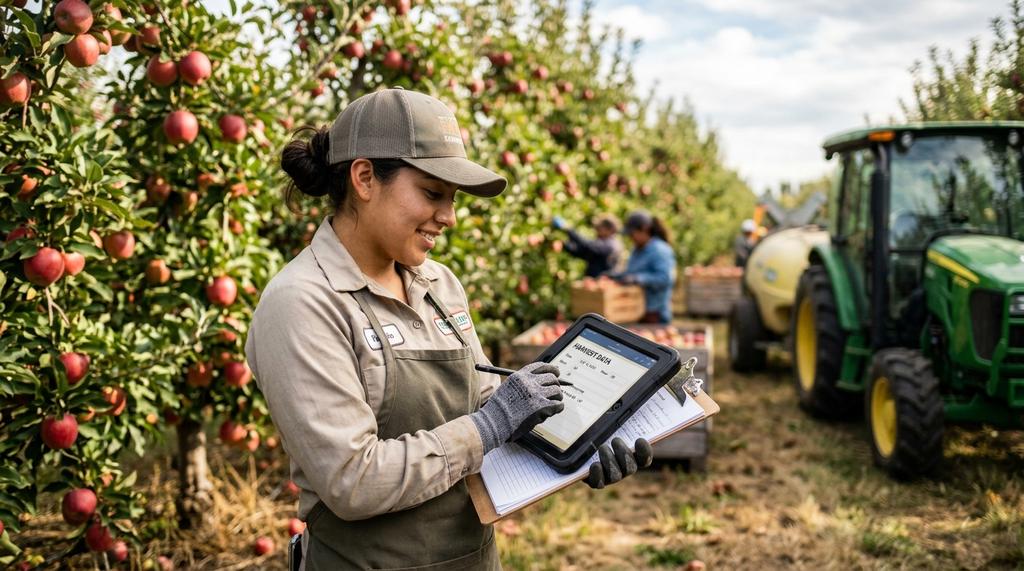
The harvesting CTE requires, at minimum, the growing-area location, the crop and variety, and the harvest date — captured at the moment bins leave the field.
On your farm, this is where bin tagging earns its keep. Croptracker's Harvest module ties every harvest event to the block, variety, picker, and date, with bin tags carrying a barcode or QR identity — pre-printed, print-on-the-go, scan-your-own, or bulk entry. It works fully offline and syncs when you're back in coverage, which matters when your blocks are beyond cell range. The Harvest Inventory Report keeps bins, balances, and inventory origins exportable for review.
One precision worth repeating: the bin tag is your lot identity in the field — but under the rule, the traceability lot code itself is not assigned at harvest. It's assigned at initial packing. Your bin tags carry the harvest KDEs that feed the TLC record.
Cooling
Cooling is a defined CTE — but only active temperature reduction of a raw agricultural commodity before initial packing: hydrocooling, icing, forced-air cooling, vacuum cooling, or a similar process. Passive long-term cold or CA storage is holding, a different activity.
Either way, the data you need is time-in, time-out, and location. Croptracker's Storage module scans inventory in and out of cold storage and controlled-atmosphere rooms with a paired scanner or device camera, putting timestamps and location detail on every move — so each lot's cooling and holding history is queryable, not reconstructable.
Initial Packing

This is the event where the traceability lot code gets assigned for produce, and where your case labels and your FSMA records become the same document. The initial packing CTE requires the TLC, the quantity, the pack style, and the linkage back to the harvest KDEs.
Croptracker's Packing module scans bins onto the pack line, records the pack event and quantity, and prints pallet tags and case labels in custom formats — which is also where TLC-linked labeling happens. For operations packing in the field, Croptracker's Field Pack module handles the same event with labels, inventory, worker productivity, and offline capability. This is the strongest link in the chain: pack the lot once, and the record, the label, and the TLC identity are one system.
Shipping
The shipping CTE requires the TLC, the quantity, and the date shipped, tied to the destination. Croptracker's Shipping module produces shipping labels, receipts, and waybills, and keeps historic shipment data by customer — with Order Desk linking products, customers, transport, and orders in one place. If your buyers require specific BOL or ASN field formats, that's worth confirming in a demo, but the underlying shipment records — lot, quantity, customer, date — are already captured at the source.
Receiving
If you receive FTL foods from others — from a partner grower, a co-packer, or a broker — the receiving CTE applies to you. You must record the TLC, product identification, quantity, and date received.
Croptracker's Receiving module records the inbound load by lot code, with supplier, block, and arrival time on one screen. There's a rule detail here that matters: if you receive an FTL food from an entity that's exempt from the rule, and no TLC has been assigned, you must assign one. Your exempt-supplier status doesn't travel with the fruit. The receiving record is where that TLC-assignment workflow lands in Croptracker.
Transformation
Transformation — commingling, cutting, trimming, repacking, or changing the food — creates a new TLC while requiring records that connect the new code back to every input lot. Croptracker's Packing module consumes input lots into product creation and records culls and inventory changes from drying, cutting, or long-term storage, with packing records staying linked to the harvest and received-inventory records behind them. Input lot records remain linked to the new lot, which is the internal record-keeping the rule's one-step-forward, one-step-back expectation depends on.
Paper, Spreadsheets, or Software: Making the Record-Keeping Decision
Honest assessment time. The rule doesn't mandate a system — it mandates records, 24-hour production, and a sortable spreadsheet. So when is paper genuinely enough?
- Paper works for very small operations with one site, one commodity, low lot volume, and a full-time records keeper — until a 24-hour request lands during harvest. Then it doesn't.
- Spreadsheets work better, until multiple people, multiple sites, and multiple lot identities collide. Spreadsheet archaeology is the single most common failure we see in the 24-hour drill: the data exists somewhere, but not in one sortable place, and not within a day.
- Software earns its cost the moment your operation has field crews, a pack line, storage rooms, and shipping docs — because the CTE data already exists as real events, and the only question is whether it gets captured at the event or reconstructed afterward.
That's the honest trade-off, and it's also why traceability records belong in your farm operations system rather than a bolt-on compliance tool. The harvesting, cooling, packing, and shipping data isn't compliance data — it's your operating data. Croptracker captures the records the rule requires at the events where they happen, in one system from field to shipment, with reports exportable to Excel, CSV, or PDF. To be precise about what compliance means: there is no such thing as "FSMA 204 certified" software — the rule certifies no one. What you're evaluating is whether the records get captured completely at the source.
Growers already running the system don't experience this as a compliance project. At Mr Apple, harvest and post-harvest digitization saves 600–800 hours per week of labor reconciliation. Taggares Fruit Company tags and scans around 2,000 bins per day with pre-printed tags and offline scanning. Welsh Bros links every worker to every bin. The data that satisfies an FDA request is a byproduct of running harvest well.
Questions to Ask Any Traceability Software Vendor
If you're evaluating vendors — and you should be doing it in 2027, not 2028 — this is the buyer's checklist, mapped directly to the rule's requirements. Any "FSMA 204 ready" claim should survive these questions:
- Does it capture harvest KDEs at the point of event — block or growing area, crop, variety, date, and crew — on mobile, offline, in the field?
- Does it assign TLCs at the correct events — initial packing, transformation, or receiving from an exempt supplier — not just print barcodes?
- Does it maintain farm-map and growing-area records with location detail, retrievable across at least two years?
- Does it record storage time-in/time-out by lot with room-level location detail?
- Does it link transformation records so input lots stay connected to the new lot they became?
- Does it export to Excel or CSV in a sortable format compatible with FDA's spreadsheet structure — columns, not PDFs?
- Does it support two-year record retention with queryable history, not rolling deletion?
- Is there an API for supply-chain sharing, so your data can move to buyers and downstream partners in their formats?
- Does it have produce-industry track record — bin tagging, pack lines, CA storage, sales desks — not generic form-building?
That last question is the differentiator. Traceability software varies widely: form-builder tools, hardware-and-labeling vendors, and farm operations systems. Form builders capture whatever fields you design. But the CTE data — blocks, bins, pack events, storage rooms, shipments — already lives in the daily workflow of a produce operation. The right system captures it there, once, instead of asking your crew to enter it twice.
Your 2027–2028 Preparation Timeline
With the July 20, 2028 enforcement posture, here's a quarter-by-quarter roadmap tuned to the specialty crop calendar:
- Q4 2026 (now — audit season): Map your current state against the rule. Confirm whether your commodities are on the Food Traceability List. Identify which CTEs touch your operation. Book the traceability conversation into your winter planning cycle.
- Q1 2027 (post-harvest review): Run the 24-hour drill on one lot from last season. Document every gap — missing KDEs, disconnected records, lot identities that break at the pack line. Draft your traceability plan, including the farm map.
- Q2 2027 (pre-season): Close the data-capture gaps before crews arrive. Set up block maps, bin-tag formats, pack-line scanning, and storage room records. This is the same setup window you already use for piece-rate configuration and spray planning.
- Q3 2027 (harvest): Capture CTE data live for the full season. Nothing validates a traceability workflow like running it through a real harvest at full volume.
- Q4 2027 (wrap-up): Run the 24-hour drill again — this time as a formal mock recall with an actual clock. Train backup staff on the process. Test your sortable export against FDA's template columns.
- Q1 2028 (dry run): Simulate an FDA request end to end. If the report comes back complete, sortable, and on time, you're ready. If it doesn't, you have two more seasons of runway to fix it — starting with the same drill.
Notice what's missing from this timeline: a scramble. Every step is work you should be doing anyway — better block records, cleaner bin tagging, tighter pack-line tracking — redirected toward a regulatory payoff.
Frequently Asked Questions About FSMA 204 Traceability
Q: What is the FSMA 204 compliance deadline now? A: As of October 2026, FDA's stated posture is that the Food Traceability Rule will not be enforced before July 20, 2028. The original compliance date was January 20, 2026. Congress directed FDA in November 2025 (H.R. 5371) not to enforce the rule before July 20, 2028, and FDA has proposed a formal 30-month extension to the same date. Because the extension is still a proposed rule, growers should confirm the current posture on FDA's rule page before finalizing plans.
Q: Does FSMA 204 apply to growers who are exempt? A: Farms with average annual sales under $25,000 of Food Traceability List foods are exempt from the recordkeeping requirements — but a buyer's requirements are not an exemption. Retailers and foodservice chains can require FSMA 204 traceability data from any supplier, exempt or not. And if you receive an FTL food from an exempt entity without a traceability lot code, you must assign one.
Q: What is a Traceability Lot Code (TLC)? A: A traceability lot code is the unique identifier the rule requires for each lot of an FTL food. It must be assigned at initial packing of a raw agricultural commodity, at transformation (commingling, cutting, repacking), or — for seafood — at first land-based receiving. The TLC stays with the lot through the supply chain, and records at every critical tracking event reference it.
Q: What are critical tracking events and key data elements? A: Critical tracking events (CTEs) are the points in the supply chain where records are required: harvesting, cooling (before initial packing), initial packing, shipping, receiving, and transformation. Key data elements (KDEs) are the specific pieces of information that must be recorded at each CTE — such as growing-area location, crop and variety, harvest date, quantity, and the traceability lot code. FDA's CTE/KDE guide lists them event by event.
Q: How long must FSMA 204 records be kept? A: Two years. The retention requirement in 21 CFR 1.1455(d) requires records to be maintained for two years, and they must be produced to FDA within 24 hours of an official request.
Q: What is the electronic sortable spreadsheet requirement? A: When FDA requests records during an outbreak, recall, or other public-health threat, you must provide an electronic sortable spreadsheet within 24 hours, unless exempt. FDA publishes an Excel template, but using it is not mandatory — a sortable file with the required data is what matters. All records, not just the spreadsheet, must be available within 24 hours of an official request.
References
- FDA — FSMA Final Rule: Requirements for Additional Traceability Records for Certain Foods (main rule page, compliance date section, CTE definitions, traceability plan, exemptions): https://www.fda.gov/food/food-safety-modernization-act-fsma/fsma-final-rule-requirements-additional-traceability-records-certain-foods
- Federal Register — Final Rule, Requirements for Additional Traceability Records for Certain Foods (Nov 21, 2022): https://www.federalregister.gov/documents/2022/11/21/2022-24417/requirements-for-additional-traceability-records-for-certain-foods
- FDA Constituent Update — FDA Intends to Extend Compliance Date for Food Traceability Rule (March 20, 2025): https://www.fda.gov/food/hfp-constituent-updates/fda-intends-extend-compliance-date-food-traceability-rule
- Federal Register — Proposed Compliance Date Extension (Aug 7, 2025): https://www.federalregister.gov/documents/2025/08/07/2025-14967/requirements-for-additional-traceability-records-for-certain-foods-compliance-date-extension
- Congress.gov — H.R. 5371, Continuing Appropriations, Agriculture, Legislative Branch, Military Construction and Veterans Affairs, and Extensions Act of 2026: https://www.congress.gov/bill/119th-congress/house-bill/5371
- FDA — Food Traceability List: https://www.fda.gov/food/food-safety-modernization-act-fsma/food-traceability-list
- FDA — CTE/KDE Detailed Guide: https://www.fda.gov/media/163132/download
- FDA — Electronic Sortable Spreadsheet Template (Excel; use not mandatory): https://www.fda.gov/media/179617/download
- FDA — Traceability Plan Example for Farms (21 CFR 1.1315): https://www.fda.gov/media/174057/download
- eCFR — 21 CFR Part 1, Subpart S (Traceability Recordkeeping, incl. 1.1455(d) retention): https://www.ecfr.gov/current/title-21/chapter-I/subchapter-A/part-1/subpart-S
- FDA — Public Meeting: Challenges and Solutions in Lot-Level Food Traceability (Nov 6, 2026): https://www.fda.gov/food/workshops-meetings-webinars-food-and-dietary-supplements/fda-public-meeting-challenges-and-solutions-lot-level-food-traceability-11062026
- FDA Constituent Update — FDA Issues Draft Enforcement Discretion Policy for Certain Small Retailers and Restaurants: https://www.fda.gov/food/hfp-constituent-updates/food-traceability-fda-issues-draft-enforcement-discretion-policy-certain-small-retailers-and
- Federal Register — Cottage Cheese Exemption Notice (Feb 20, 2026): https://www.federalregister.gov/documents/2026/02/20/2026-03362/requirements-for-additional-traceability-records-for-certain-foods-exemption-for-cottage-cheeseunder
- FDA — Produce Supply Chain Example (TLC assignment in practice): https://www.fda.gov/media/163054/download
- FDA — FSMA Food Traceability Rule FAQ: https://www.fda.gov/food/food-safety-modernization-act-fsma/frequently-asked-questions-fsma-food-traceability-rule
- CFIA — FSMA 204 Requirements for Food Exported to the U.S.: https://inspection.canada.ca/en/exporting-food-plants-animals/food-exports/requirements/fsma-204
- FDA — Exemptions Tool: https://collaboration.fda.gov/tefcv13/
- IFPA — FSMA 204 Resources: https://www.freshproduce.com/resources/supply-chain-management/fsma-204-resources/
- Produce Traceability Initiative — Resources: https://producetraceability.org/resources/