
With the ground still frozen near Croptracker’s home office, growers in the northern hemisphere are already deep in planning for the upcoming season. For specialty crop growers in particular, this period requires careful and strategic thinking to protect precarious profit margins from a perfect storm of challenges, including uncertain trade markets, persistent labour shortages, and increasing climate pressures. Every decision, especially concerning input costs, must be optimized for efficiency and compliance.
This use case article will detail the critical Croptracker features growers leverage when strategically planning their spray applications for a new growing season, covering everything from regulatory compliance and budget forecasting to determining crop-specific needs and application logistics.
Restriction, regulations and label updates
One of the first things to consider as the new year roles around is whether there have been any updates to the restrictions on the chemicals you plan to use this season. Regulations often change between seasons, and 2025 has seen several key updates, particularly in North America. Constant reviews of older chemistries (like some organophosphates or neonicotinoids) mean growers must check if a "trusted" product has new restricted-use labels or has been phased out entirely since last year.
For some growers, ensuring they are following new chemical residue limit restrictions in export markets is also important. For instance, in the past few years, the EU has implemented lower limits on glyphosate residue, impacting growers selling there.
For Croptracker’s Spray module users, when a chemical label has been updated and the restrictions around its use have changed, the chemical should also be updated in Croptracker to ensure seamless application audits. For users in North America taking advantage of our universal chemical list a simple chat or e-mail to our Croptracker support team will ensure the chemical you are using gets updated.
If you are adding and managing your own chemical list in Croptracker, you can edit the existing chemical and upload a new label. If the registration number has changed, it is advised that a new entry be made for this chemical. This will ensure all past spray records are accurate and linked to previous versions of the label.
Costing, availability and budget planning
Perhaps the biggest limiting factor when planning for sprays is the cost and availability of the products being used. Inflations on input costs are expected to continue in 2026. Many analysts are advising growers to budget for a 10–15% increase in total spray costs due to rising energy prices and (particularly in the US) new tariffs on active ingredients sourced from overseas.
As fertilizer and pesticide costs continue to increase, and global trade markets impact stock at suppliers, many growers are already used to carrying a 15-20% buffer stock of essential products they use every year. This helps create a safety net for supply issues.
Additionally, more growers are choosing to take advantage of Early-Order Programs to help manage costs. These specials are usually offered by suppliers in the fall and early winter in North America, letting growers lock in orders before price increases.
Proper FIFO inventory management can also help lower costs, ensuring older chemicals are used first, making sure no expiring dates are missed resulting in a loss of inventory.
To better support inventory management and ordering for the season, users turn to their Chemical Inventory screen. This feature allows growers to add all the chemicals they have with a cost and total amount. As sprays are applied throughout the season, they will be deducted from the totals in inventory, ensuring inventory storage records are up to date and that spray costs can be easily calculated on specific blocks, chemicals or varieties easily.
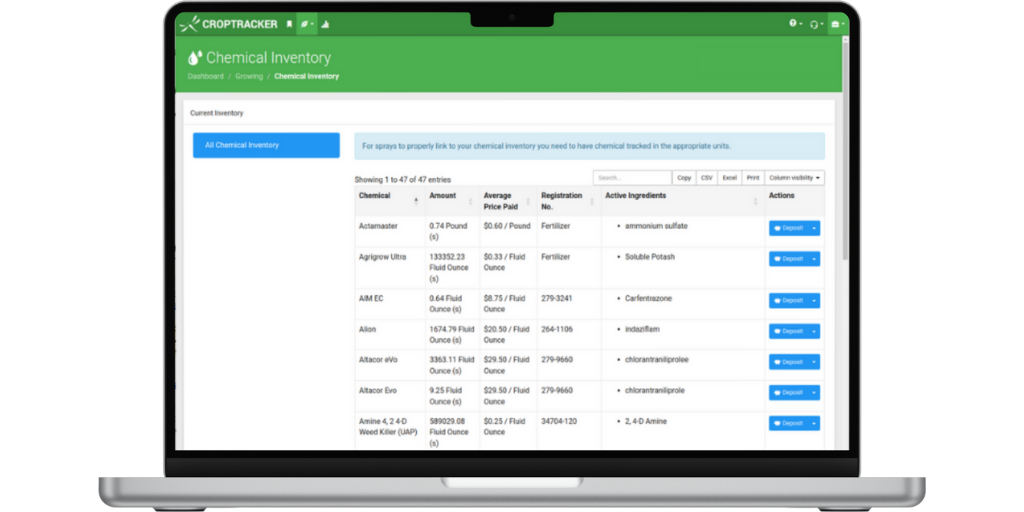
If you have an existing inventory, it is easy to record new shipments for the season by simply adding a chemical Deposit. Additionally, if the price of the chemical has increased for this season, the cost of the chemical can be adjusted for accurate cost calculations in the upcoming season. If you would like support resetting your chemical inventory for the season or setting it up for the first time please contact support@croptracker.com and our team will be happy to help.
Additionally, Croptracker users can start estimating the costs and chemical totals they will need for the season with the Spray Plan feature. Spray Plans function just like Spray events in Croptracker in that they will calculate the chemical totals and tank mix ratios needed based on the size of the growing area being treated, however, they do not draw from the Chemical Inventory or impact any Spray reports.
Croptracker's Spray Plan feature allows users to begin estimating the seasonal costs and total chemical requirements. Functioning similarly to a standard Spray event in Croptracker, a Spray Plan calculates the necessary chemical totals and tank mix ratios based on the size of the area being treated. However, it is important to note that unlike a Spray event, a Spray Plan does not deduct from the Chemical Inventory or influence any Spray reports.
This means users can add their planned applications for the season, determine the total amounts of each chemical and order what is needed. As a bonus, Spray Plans can be easily converted to Spray events when the time comes to apply, saving time on double entering data. The date, time and weather conditions can all be adjusted on the app or from your browser when the spray happens, ensuring food and worker safety and proper audit reporting.
Spray Plans offer another convenient advantage: they can be effortlessly transformed into Spray events when the actual application occurs, eliminating the need for duplicate data entry. When the spraying takes place, users can easily adjust the date, time, and weather conditions either through the app or a web browser. This flexibility is crucial for maintaining food and worker safety standards and ensuring accurate audit reporting.

What inputs do your crops need this year?
Ultimately, the real work of spray planning is in determining what your soil and crops need this year. For seasonal vegetable crop growers, applications will be dictated largely by the planting and rotation schedule. What was planted last year? What are your soil testing and scouting records from last season telling you? This will greatly impact the nutrient make up and pest pressures of the growing area and what should be applied this season.
Making sure new plantings are mapped in Croptracker prior to planting will boost spray planning, ensuring any Spray Plans and Chemical Inventory changes are related to the new season’s crops and not the last. For effective advanced spray planning, ensure new plantings are mapped in Croptracker before they go into the ground for the season. This guarantees that all Spray Plans and adjustments to Chemical Inventory are correctly linked to the current season's crops, not those from the previous year.
For permanent crop growers, the age of the plantings will also dictate the treatments and nutrients needed. First year seedlings have very different treatment requirements than established orchard blocks. In Croptracker, the planting date, rootstock and soil quality data added to the Field Map make it easier to assess what will be needed this season at a glance.

Checking regional extension programs, government agricultural resources and neighbours can also be a great help in planning for emerging pests and disease pressures expected for the season. Pests like the Box Tree Moth and Japanese Beetle have recently expanded into new regions (like the Canadian Maritimes and parts of BC). Growers in "newly infested" zones should add these to their scouting checklists for the first time. Croptracker’s support staff can help ensure our global pest list and your Quality Control scouting templates are updated ahead of the season if you are battling something new.
Another consideration for this season’s spray planning is what was sprayed last year. Was the timing and treatment effective and should it be adjusted this year? Are you focused on avoiding resistance through alternating different Modes of Action (MOA)? In Croptracker, tracking the active ingredients in each chemical can help ensure you are alternating MOA’s to help manage resistance and target pests and disease effectively.
When do you need to be ready to spray?
As every grower knows, the season will not wait for you. It is critically important to work backwards from your planned application dates when ordering, scheduling equipment maintenance and training staff for performing sprays. Have all your licenced applicators been added to Croptracker and do they need training on how to edit and update Sprays in Croptracker? Get in touch if you need help with this set up.
As mentioned, ordering inputs earlier will help save money, but it will also ensure you actually get what you need in time. Additionally, performing and recording equipment maintenance sooner will help make sure you can troubleshoot issues before it causes delays. Croptracker’s Spray module uses information about the sprayer, tank size, nozzle type and application pattern to calculate chemical totals so ensuring these are up to date in the system before you start spray planning will keep your chemical amounts accurate.

Ultimately, strategic spray planning is a complex yet necessary component of a profitable growing season. By integrating their planning process with Croptracker’s comprehensive features, growers can move beyond simply tracking applications to actively forecasting costs, ensuring regulatory compliance, and making data-informed decisions. The Chemical Inventory screen, Spray Plan feature, and up-to-date Field Map data combine to create an essential workflow.
Croptracker helps growers to confidently manage the moving targets of the season, be it fluctuating input costs, changing chemical labels, or emerging pest pressures. By planning early, optimizing inventory through FIFO, locking in Early-Order Programs, and ensuring their equipment and staff are ready, Croptracker users are equipped to start the season with maximum efficiency and a clear path to achieving their target Return on Investment.